


Album Preview: Dusty Coyote Keep Garage Rock Scruffy and Unfiltered on More Cowbell

Somewhere in Ontario, four musicians are making enough racket to wake the neighbors, piss off the algorithm, and remind everybody why playing in a band is supposed to be fun in the first place.
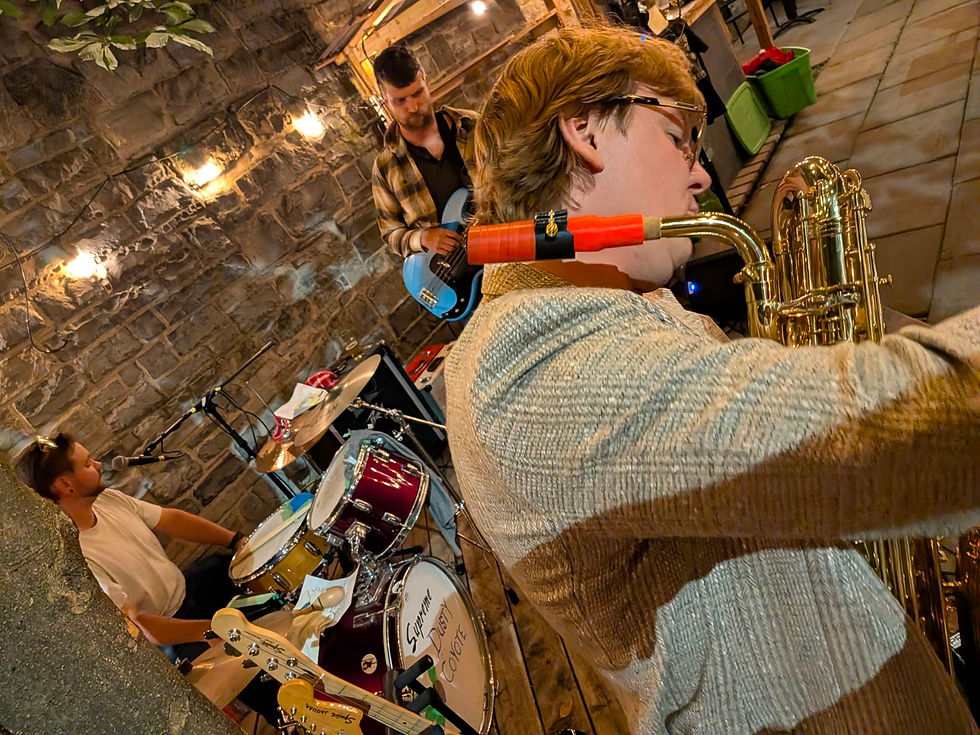
Meet Dusty Coyote, a garage-rock outfit operating out of the Kingston and Gananoque area, where surf guitar crashes into baritone sax, funk-punk grooves get their hands dirty, and the recording process doesn't require a digital babysitter. Their EP More Cowbell was tracked live, without a click track or autotune. Imagine that, four dudes in a room, reacting to each other in real time.

FFO: Thumpasaurus, Sugar Pit, Zookraught
In an era where every release arrives with a marketing funnel attached, there's something refreshing about a band willing to leave a little dirt on the tape. Dusty Coyote aren't chasing some immaculate studio mirage. They're chasing the electricity that happens when musicians lock into a groove, push each other around, and occasionally let the whole thing get a little out of hand. As the group puts it: “Because that's what the band actually sounds like.”
The title More Cowbell practically announces its intentions before the needle even drops. Dusty Coyote's self-described blend of scruffy garage rock, surf guitar, baritone sax, and funk-punk pulse suggests a sound more interested in movement and personality than genre obedience.
The live-recording approach is central to that identity. Without a click track dictating every millisecond, a song can breathe, stumble, accelerate, and recover. A little human unpredictability becomes part of the arrangement rather than a mistake waiting to be corrected. There's a larger philosophy buried in that decision, too. Technology can be a fantastic tool, but it can also become another authority telling musicians what their work should sound like. Dusty Coyote are happy to use modern tools to distribute their music, but they aren't interested in letting those tools dictate what happens in the rehearsal room.
Their attitude is simple: make the music, share it with people, and get back to making more music. No elaborate content calendar or release strategy required.
Dusty Coyote's Small Town, Big Noise
The band's home territory around Kingston and Gananoque might not be the first place that comes to mind when you picture the international underground, but Dusty Coyote describe a scene packed with talent and sustained by people who put in the work.
Independent venues take chances on local acts. Bands support each other's shows. Community radio gives unfamiliar music a shot. Audiences actually leave their houses and show up. That last part shouldn't be revolutionary, but here we are.

Dusty Coyote point to CFRC's support for More Cowbell and an opportunity to open for Canadian roots-rock institution The Sadies as meaningful milestones. These aren't just names to drop on a press release; they're examples of what can happen when a local network creates room for bands to grow.
For a DIY outfit, a radio DJ spinning your record or another band helping you land a gig can mean more than an anonymous spike in streaming numbers.
Those connections build a scene that exists beyond a dashboard, and according to Dusty Coyote, that's the part worth protecting.
Of course, making music in the modern era means navigating a bizarre digital landscape where a band can theoretically reach listeners on the other side of the planet while struggling to get someone down the street to attend a show.
Dusty Coyote see the possibilities. Streaming platforms and online distribution have opened doors that once required record-label backing, expensive promotion, or a whole lot of luck. But the band is wary of turning the pursuit of visibility into a full-time job that leaves no time for the actual music.
They're doing much of the outreach themselves, connecting directly with radio programmers, independent publications, fellow bands, and listeners who connect with what they're creating. Then they return to the room and make some noise. That distinction matters. The underground's never survived on music alone. It survives because people build relationships around it, create opportunities for each other, and keep showing up even when the numbers aren't particularly impressive.
Dusty Coyote would rather cultivate those relationships than treat every other band as competition. There's room for more than one act to find its audience, and the scene gets stronger when everybody stops guarding the door.
Next Up: “Hot Coffee”

Dusty Coyote's next chapter arrives with “Hot Coffee,” announced for release on November 20th. The band describes the upcoming single as part of a longer musical adventure: more records, more shows, more places to play, and more people to connect with along the way. They're interested in reaching a bigger audience, sure, but not if getting there means sanding away the rawness that made the band worth hearing in the first place.
Dusty Coyote's appeal starts with a familiar but increasingly valuable idea: a band should sound like a band. Not a collection of perfectly aligned digital performances. Not a playlist strategy wearing a leather jacket. A ragtag group of artists making decisions together, leaving space for spontaneity, and building something that belongs to them.
Their commitment to a hands-on recording process is only one part of the picture. The other is a DIY outlook that extends beyond the studio and into the community around them. Local radio, shared bills, independent venues, direct outreach, and mutual support aren't side quests. They're the infrastructure that allows underground music to exist.
“Hot Coffee” is on the horizon, and Dusty Coyote are playing the long game.
We'll take a little human chaos over another algorithm-approved product any day.

Q: What's the current DIY scene like in Ontario, and how has local support shaped Dusty Coyote as a band?
A: Around Kingston and Gananoque, there's a lot of talent packed into a fairly small area. The DIY scene runs on venues willing to take a chance, bands supporting each other's shows, people at community radio, and music fans who actually show up.
CFRC gave our More Cowbell EP some great support, and we've had the opportunity to play with bands we really admire, including opening for The Sadies. Those things mean a lot when you're doing this yourself.
Q: With music culture constantly shifting, how are you approaching making and sharing music in this current era?
A: We're trying to use the modern tools without letting them dictate the music. It's pretty amazing that a four-piece from a small Ontario town can reach DJs and listeners on the other side of the planet, but it's also easy to spend every day chasing numbers.
We're doing a lot of the work ourselves, talking directly to radio people, other bands, little publications and anybody who connects with what we're doing. Then we get back in a room and make some noise. That's still the fun part.
Q: More Cowbell was recorded live without a click track or autotune. What drew you to that raw approach, and how does that ethos reflect your views on music culture today?
A: Because that's what the band actually sounds like. Four guys playing together, reacting to each other, speeding up a hair when it gets exciting, and leaving a little dirt on the recording. That's where the personality lives. There are plenty of good uses for technology, but we didn't want to sand off the very thing that makes playing in a band exciting for us. No click. No autotune. No problem.
Q: Given the current state of the world, how do you see the social dynamics within independent music playing out compared to broader society?
A: There's plenty of competition and noise in music, just like everywhere else. But the part of the independent scene that we love is the opposite of that. Somebody gives you an opening slot, another band helps find a show in a new town, a DJ takes a chance on something weird. We'd rather build those relationships than act like everyone else is competition. There's room for more than one band to do well.
Q: As you prepare for the release of "Hot Coffee"and look ahead, what are your ultimate hopes and dreams for this musical journey?
A: Mostly we want to keep making records that sound like us, play more shows in more places, and find our people along the way. "Hot Coffee" comes out November 20th, and we have a lot of fun ideas around it. It would be great to reach bigger audiences, of course, but not at the expense of what makes the band fun. We want this to be a long adventure, not a quick flash.

Stay Tuned:
Listen: Dusty Coyote on Spotify
Pre-Save Upcoming Single: “Hot Coffee”


Comments